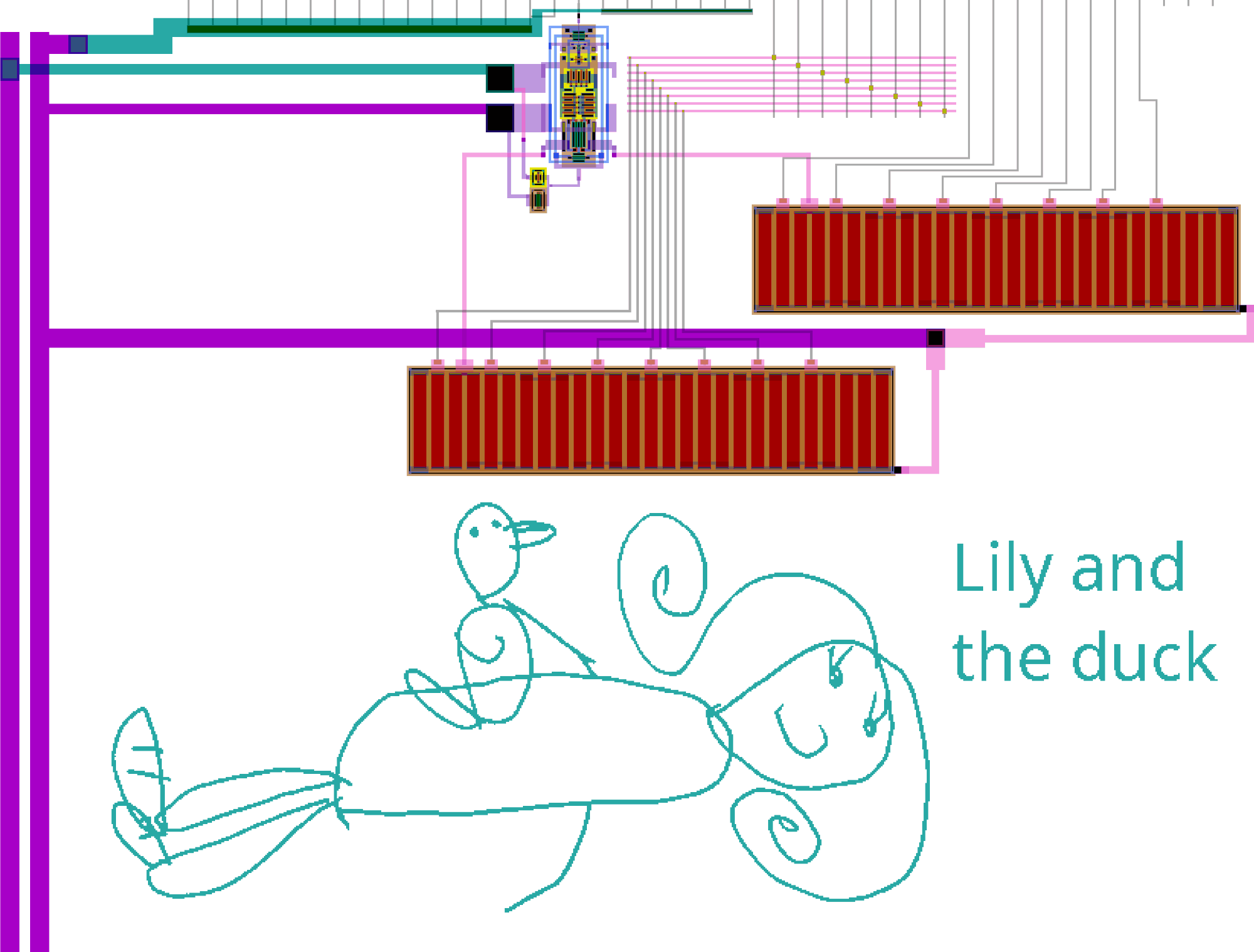
617 Simple comparator + 2 DACs analog layout in a 1x1 tile

617 : Simple comparator + 2 DACs analog layout in a 1x1 tile
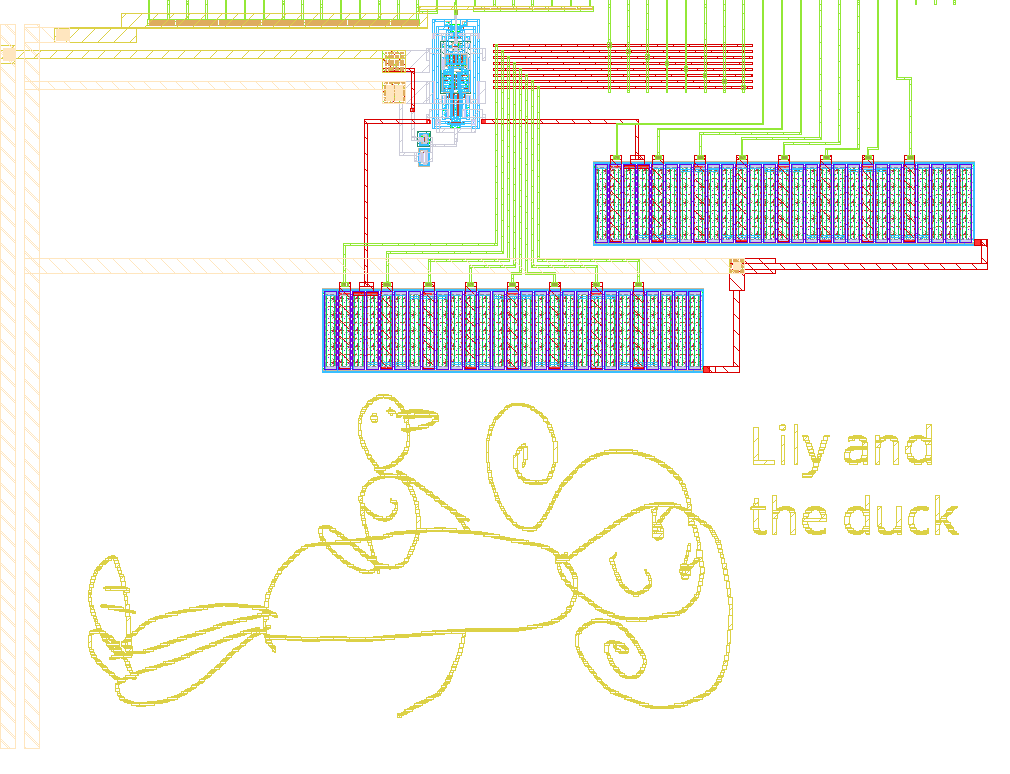
Design render

What is this project?

Custom GDS layout for tt_um_algofoogle_analog_junk

This custom GDS layout uses Tiny Tapeout 1x1 tile space normally intended for digital-only projects, and implements 4 analog elements that provide a basic testing harness for a simple analog comparator. ui_in and uio_in (the bidirectional pins) respectively drive DACs to set two voltages to be compared, while comparator_out provides the digital comparison result: high if ui_in is greater than uio_in, or low if uio_in is greater.

The output is estimated to be reasonably accurate for DAC codes 64..213 (0.3V to 1.0V).

The GDS art in the bottom half is a drawing done by my daugther when she was 4.

How does it work?

Overview

This design can only interface with the outside world using digital IOs (since it is using a Tiny Tapeout 1x1 tile which has no analog ports), and since it is an analog experiment it needs a way to control analog values internally from digital inputs.

I used a simple 8-bit R2R DAC design and created two instances of it: one driven by inputs on ui_in (aka pdac) and the other on uio_in (aka ndac). These connect to the positive and negative inputs of the main target of this design: A simple analog comparator. It amplifies the difference between the positive and negative inputs to produce a digital output (comparator_out) which is high when the selected positive value is greater than the negative value, and low otherwise.

Analog blocks

The comparator is a simple design:
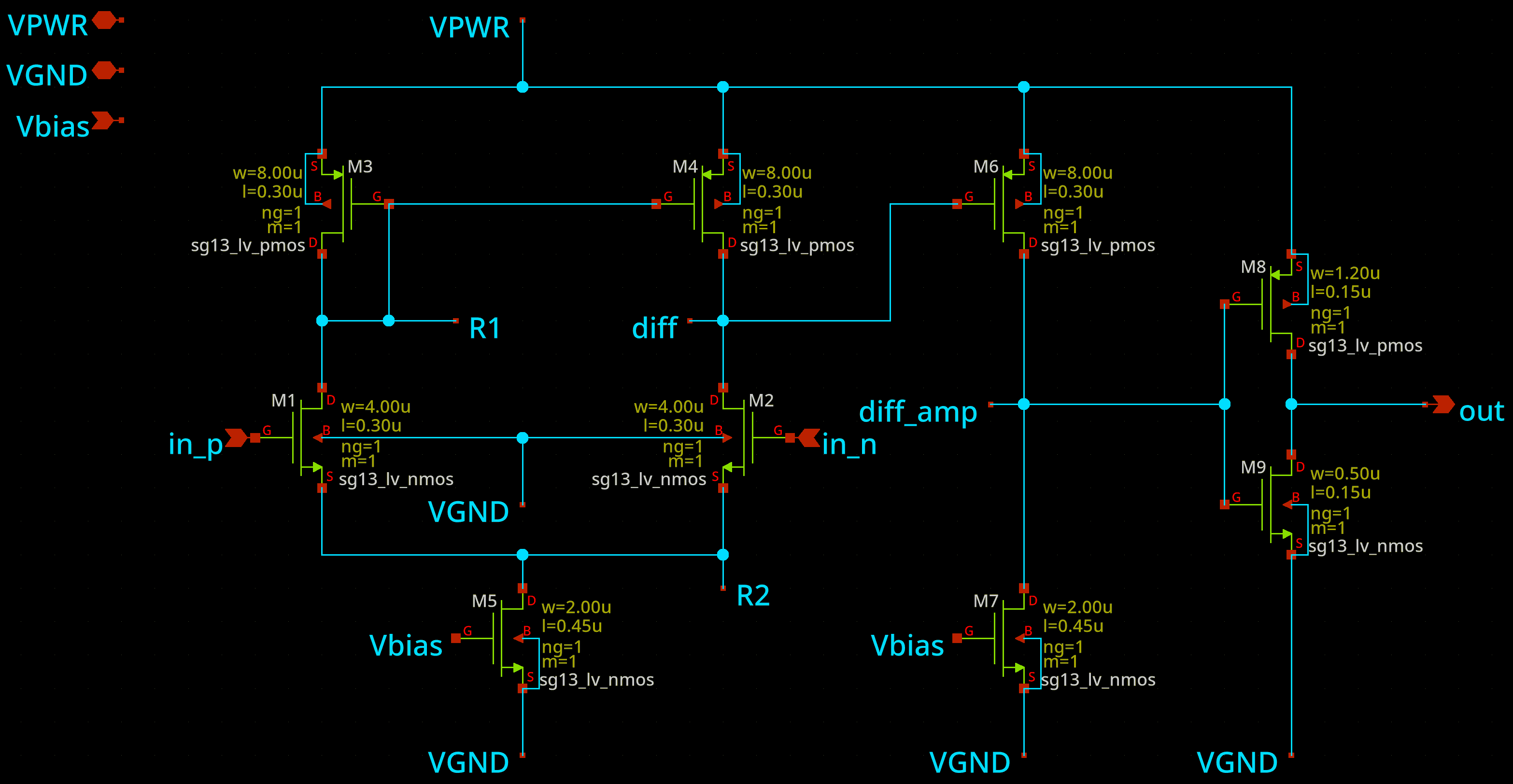
Comparator schematic

With its layout I tried to use a sensible symmetry/matching approach:
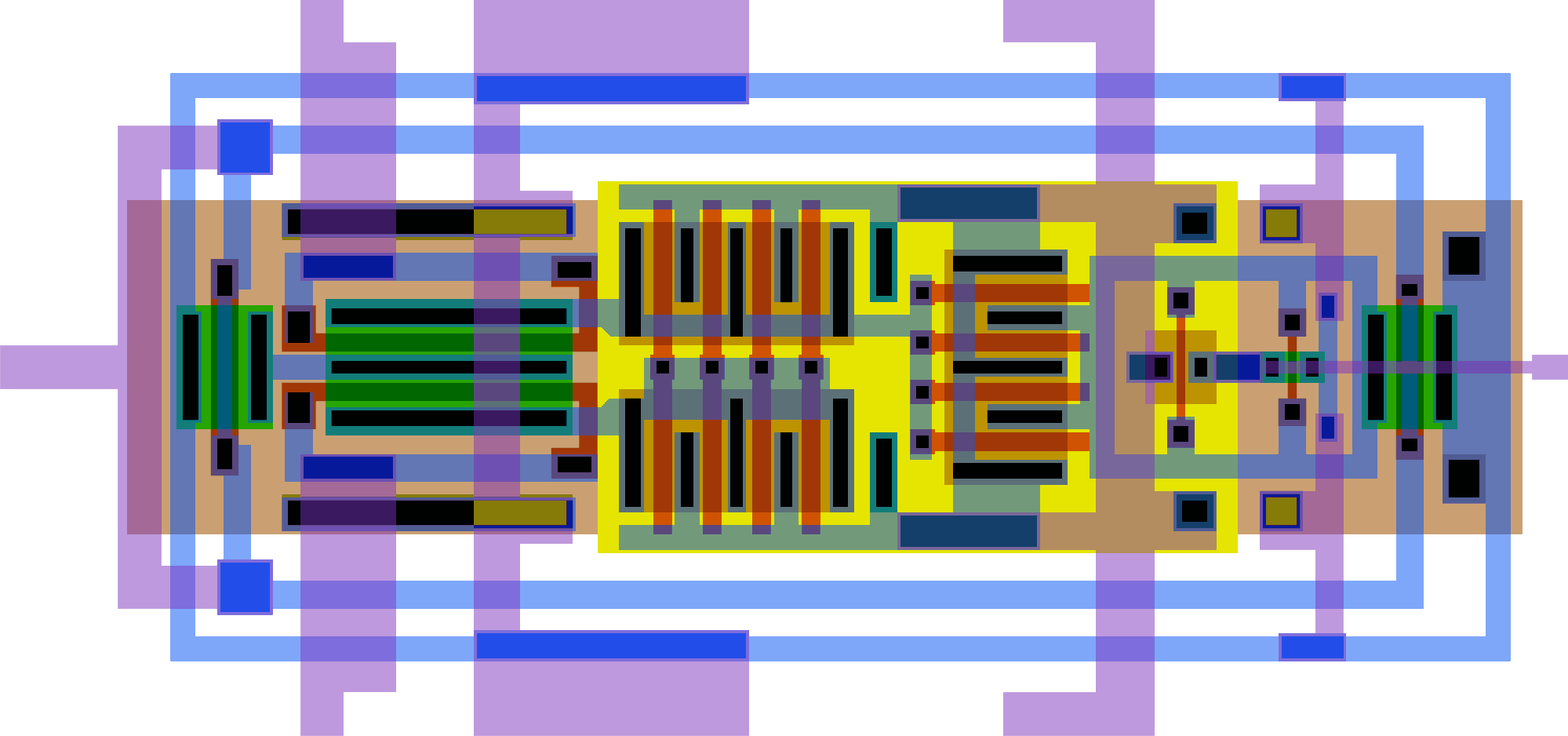
Comparator GDS layout

The comparator's M5 transistor provides the tail current, and it is matched with M7. The gate reference voltage for these is created by the naively simple Vbias circuit (for which there are probably many better designs I could have used but this is adequate for this very simple design, I think):
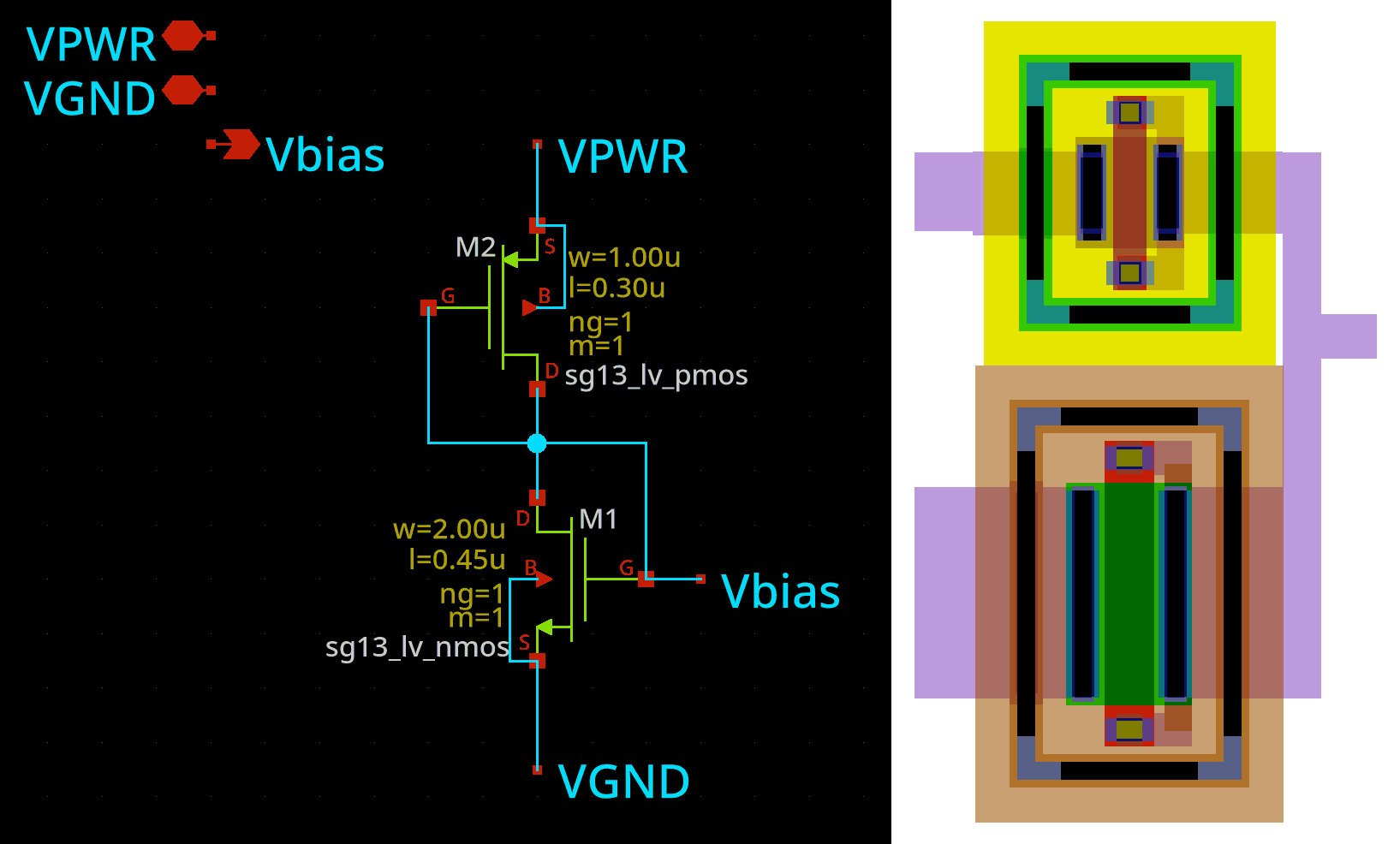
Vbias schematic and layout

The comparator's positive ("in_p") and negative ("in_n") inputs are analog voltages that can be set to anything in the range of 0 to 1.2V (with a step size of ~4.7mV per each of the 256 DAC input codes). The two DACs are a simple R2R design with a target R=10k:
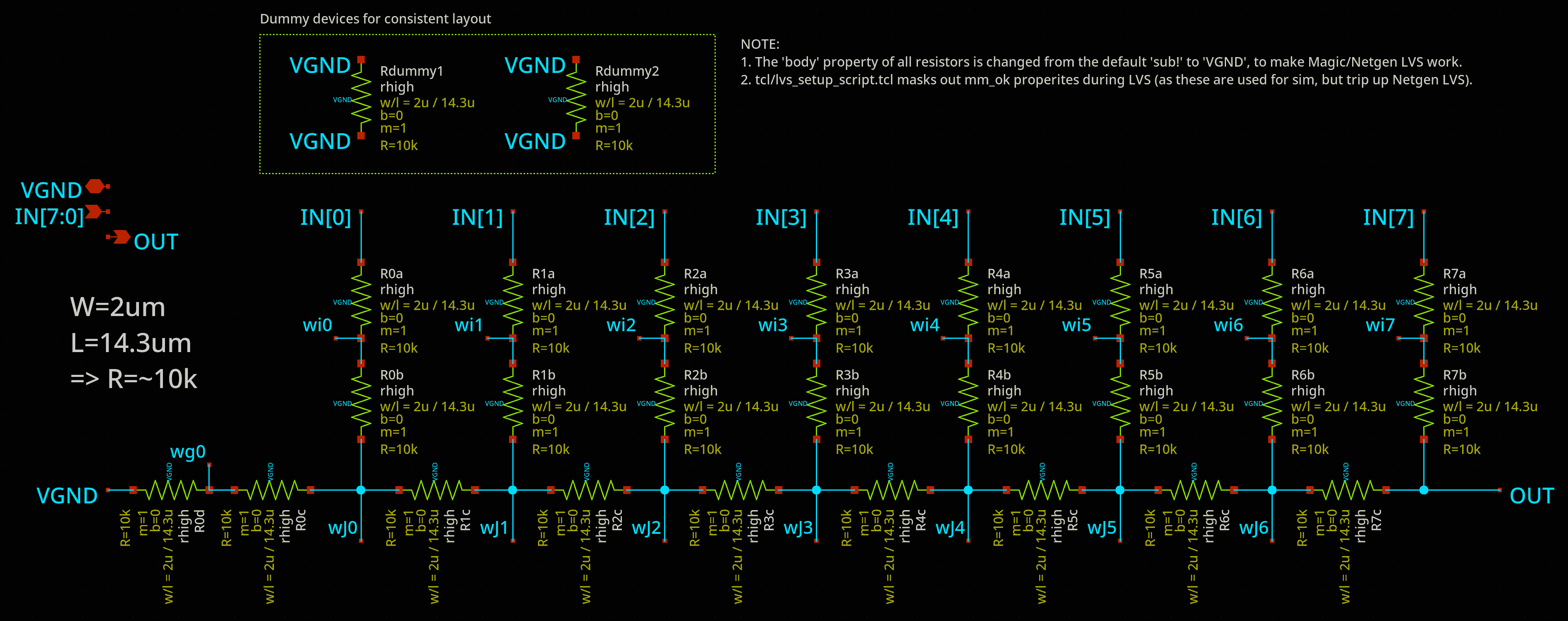
R2R DAC schematic

The layout attempts to respect matching, including the use of a dummy resistor at each end:
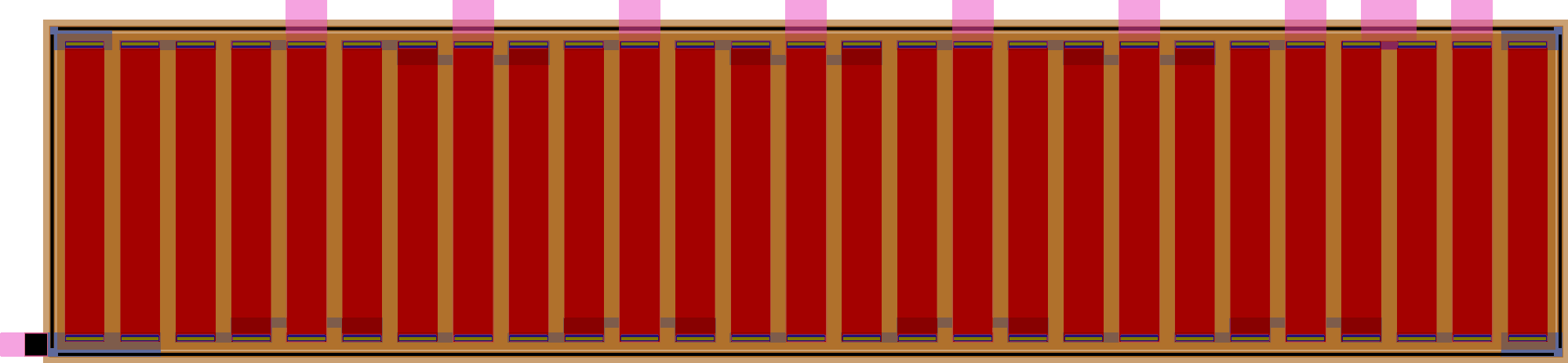
R2R DAC GDS layout

Performance

Due to having very little time to work on this, I can't say that I'd expect it to perform very well in silicon and across PVT. Nevertheless, parasitic extraction and simulation indicates it should be able to compare voltages reasonably well in the range of 0.3V to 1.0V, to an accuracy of 5mV or better (hopefully able to discriminate DAC inputs that are only 1 code apart).

How to test

This design doesn't use the clk or rst_n pins. The bidirectional pins are permanently configured as inputs.

Try comparing values on ui_in with those on uio_in -- if ui_in is greater, uo_out[7] should go high. Note that the comparator is generally considered to be reliable for voltages in the range of 0.3V to 1.0V internally (DAC codes 64..213). Voltages in range of about 0.45V to 0.85V should give the fastest response (on the order of 2-3ns) while codes nearer 0.3V and 1.0V might respond much slower (on the order of 10-20ns).

External hardware

Not much is needed to test this. The Tiny Tapeout demo board, when configured to drive the bidirectional pins, is quite an easy way to assert the ui_in and uio_in binary values to the DACs, and uo_out[7] (comparator_out) can then be observed to see the result.

Besides that, you might want an oscilloscope to measure the output in response time with respect to changing inputs.

IO

#InputOutputBidirectional
0pdac[0]ndac[0]
1pdac[1]ndac[1]
2pdac[2]ndac[2]
3pdac[3]ndac[3]
4pdac[4]ndac[4]
5pdac[5]ndac[5]
6pdac[6]ndac[6]
7pdac[7]comparator_outndac[7]

Chip location

Controller Mux Mux Mux Mux Mux Mux Mux Mux Mux Mux Analog Mux Mux Mux Mux Mux Mux Mux Mux tt_um_chip_rom (Chip ROM) tt_um_factory_test (Tiny Tapeout Factory Test) tt_um_ieee_LDO (LDO) tt_um_chip_ieee_analog (IEEE Bandgap Reference) tt_um_snn_voice_calculator_mauro_ciccone (snn-voice-calculator) tt_um_hx2003_delay (4 Channel - 32 Tap Programmable Delay with Delay Locked Loop Calibration) tt_um_adxl362_test (tt_um_adxl362_test) tt_um_larsnit_cfar (1D CA/GO/SO CFAR radar detector) tt_um_abeccari_swsynth (Sine Wave Synthesizer) tt_um_dpi_adexp (AdExp DPI Neuron ) tt_um_140oo041_fpu130 (FPU-130) tt_um_blonghi_uart (uart) tt_um_directsgg_mini_proceo_8bit (Mini 8-bit Processor) tt_um_umaece1982_lfsr (Low-Power LFSR-Based Test Pattern Generator) tt_um_deploy_timer (launch deployment timer) tt_um_urish_simon (Simon Says memory game) tt_um_nimelli_kinematic_wave_engine (Kinematic Wave Engine) tt_um_multi_seg_monitor (Multi Segment Monitor) tt_um_UART_TX (project) tt_um_crc8_lfsr (CRC-8 Serial LFSR) tt_um_tinynpu4 (TinyNPU4) tt_um_alu_bns (6-bit multi function ALU ( eldawly_V2) ) tt_um_echoworld424_tpv (Timing-Prediction Test Vehicle) tt_um_gyro_lockin (Laser Gyro Lock-in Readout Core) tt_um_josue_olivos_sar_adc (4-Bit Charge-Redistribution SAR ADC Controller) tt_um_flower (VGA Flower) tt_um_vperumal_l1_fabric (Scalable Banked L1 Memory Fabric for Edge AI) tt_um_preinception_top (Preinception: Simple Compute Accelerator) tt_um_italu (iTALU: Interactive Testable Arithmetic Logic Unit) tt_um_neuron (4-Input Signed Neuron / Perceptron) tt_um_4tap_mac (4-Tap Signed MAC Unit) tt_um_mac_engine (DSP MAC Engine) tt_um_crypto_led_demo (QAMER CryptoUART: Encrypted UART with LED Status) tt_um_layernorm (LayerNorm) tt_um_ez130_8t_mystery (EZ130 8T Mystery Circuit) tt_um_sent2spi (SENT Receiver with SPI Interface) tt_um_llr_hepiarisc (Hepiarisc with SPI flash) tt_um_rebeccargb_vga_pride (VGA Pride) tt_um_hasi_ising (Oscillator Ising Machine) tt_um_c061618g2 (Circuitli C061618G2) tt_um_tiny_dram_pim (Tiny Dual-Channel DRAM-PIM Controller + PU) tt_um_Tbilisi_CORDIC_Engine (Tbilisi CORDIC Engine) tt_um_rahulmascarenhas_folded_nn (Frozen ternary backbone + loadable head) tt_um_miniMAC (miniMAC_IHP26b) tt_um_rumcajs (IEEE DOORSH) tt_um_sg13g2_mystery (SG13G2 Mystery Circuit) tt_um_ULSR88 (ULSR demo) tt_um_ez130_7t_mystery (EZ130 7T Mystery Circuit) tt_um_tinyopt4 (ieee_tt_tinyopt4) tt_um_vga_example (IEEE VGA Animated Beach) tt_um_hyphen133_drone_detection (IEEE Acoustic Drone Detector) tt_um_nuatlabs_fifo_pwm (Async FIFO with CDC + PWM Peripheral) tt_um_nuatlabs_uart (8N1 UART Transceiver) tt_um_eeg_threshold_detector (IEEE Digital EEG Threshold Event Detector) tt_um_smart_traffic (Smart Traffic Light Controller) tt_um_94442024_mini_cpu (Mini 8-bit Accumulator CPU) tt_um_wokwi_475369131246576641 (IEEE_UPB_TT_1) tt_um_aion (AION) tt_um_rebeccargb_hardware_utf8 (Hardware UTF Encoder/Decoder) tt_um_rebeccargb_universal_decoder (Universal Binary to Segment Decoder) tt_um_rebeccargb_intercal_alu (INTERCAL ALU) tt_um_flappy_bird (IEEE Flappy Bird VGA Game) tt_um_oryan01_alu (ALU CASS PUCV) tt_um_S4xU4 (S4xU4) tt_um_vga_ca (Space CA) tt_um_llr_simplenpu (simple SPI flash streaming NPU) tt_um_pucv_pspwm (3LFCC PS-PWM Modulator) tt_um_yuri_fpga (Tiny FPGA) tt_um_mikailgedik_inverted_inverters (Inverted inverters) tt_um_esauqch_hamming74 (Hamming(7,4) encoder/decoder (IEEE)) tt_um_hackin7_analog_experiments (TinyAnalogExperiments) tt_um_snake (snake game) tt_um_mini_kraken (Kraken IO Subprocessor) tt_um_fabien_pio (AstraPIO) tt_um_chiplab (ChipLab) tt_um_wokwi_475490677474407425 (Tiny_Divider) tt_um_c061618g2tr (Circuitli C061618G2TR) tt_um_catalinlazar_nanopio (nanoPIO) tt_um_catalinlazar_uart_spi_i2c_bridge (UART-SPI-I2C Bridge) tt_um_enzonappi_sent_i2c (SENT to I2C bridge) tt_um_kush1434_proof (Proof) tt_um_schwallsunk_signal_discriminator (Highspeed voltage discriminator) tt_um_tiarinix_ttihp_verilog_template (8-bit educational SAP-style CPU) tt_um_vga_glyph_mode (BOOTCAMP) tt_um_GiulioGirelli_packet_processor (Configurable Low-Latency Match-Action Packet Processor) tt_um_vga_tictactoe (Tic Tac Toe) tt_um_vga_dvd_player (DVD player) tt_um_clea_katseye_rain (KATSEYE) tt_um_romd_uart_hello (UART Hello World) tt_um_vga_snake (CDM PYTHON GAME) tt_um_vga_slot_machine (tt_um_vga_slot_machine) tt_um_jet_seq8b (SEQ8 Programmable Sequencer) tt_um_kibo_leak_inspect (KIBO Leak-Inspection Target Controller (VGA)) tt_um_endless_runner (Endless Runner) tt_um_omega_infinity_kaoru (OMEGA INFINITY KAORU 3D Metal Grid Processor) tt_um_nikleberg_mixer (Mixer) tt_um_lahnb_sgdma (TinyDMA: A Descriptor-Based Dual-PSRAM Memory Mover) tt_um_gstj_lockin (Digital IQ Lock-in (IEEE)) tt_um_benpayne_ps2_decoder (PS/2 Keyboard Decoder for 68k) tt_um_cass_s_ui_neuron_lif (Neurona LIF con Aprendizaje STDP Dinamico (IEEE)) tt_um_vga_glyph_mode_CDM_Matrix (CDM Matrix) tt_um_qd39l_xor_stream (Fixed-ROM XOR Stream Engine) tt_um_conv3x3 (3x3 Clock Rate Streaming Input Convolution Engine) tt_um_mc14500b_soc_extended (MC14500B Extended 1-bit Microcontroller SoC) tt_um_vga_hypno_spiral (tt_um_vga_hypno_spiral) tt_um_mattizen_morse_tree (Morse Tree LED Decoder) tt_um_CDM (Colegio de Muntinlupa DVD-like Display) tt_um_romd_uart_loader (UART SPI RAM Loader) tt_um_TscherterJunior_stapel_geraet (stapel gerät) tt_um_das2225_dna_accel (DNA_Accel) tt_um_tinysoc (TinySoC) tt_um_barrel_shifter (Barrel Shifter) tt_um_approx_mac_coprocessor (Approximate DSP: Time-Multiplexed MAC Coprocessor) tt_um_joesagents_market_split_oracle (Market-split oracle) tt_um_mgpauly1458_ringmeter (Ring oscillator frequency meter) tt_um_pettit_prism_lite (PRISM with Risc-V (TinyQV) SoC) tt_um_workshop_cpu (IEEE Workshop Simple CPU) tt_um_algofoogle_analog_junk (Simple comparator + 2 DACs analog layout in a 1x1 tile) tt_um_lkhanh_cordic (TinyQV SoC (Dual Memory Backend)) tt_um_4x4npu (4x4NPU: Dual-Lane INT4 Neural Accelerator) tt_um_abiaselli_izh_bridge_3x2 (Izhikevich event bridge (4 contexts)) tt_um_fabulous_ihp_26b (Tiny FABulous FPGA) tt_um_zanderivo_voronoi (Four-Metric VGA Nearest-Prototype Visualizer)