909 Asynchronous Self-Timed Multiplier
909 : Asynchronous Self-Timed Multiplier
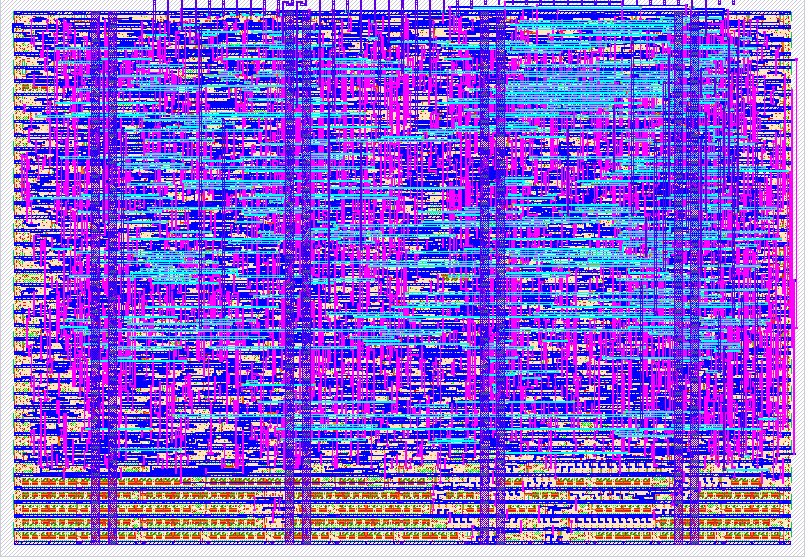
- Author: Tommy Thorn
- Description: An asynchronous self-timed bundled-data multiplier
- GitHub repository
- Open in 3D viewer
- Open in Tiny Tapeout Explorer
- Clock: 0 Hz
How it works
This design is an exercise in a particular flavor of asynchronous logic, known as "bundled data". In bundled data logic there is no global clock; instead stages communicate when data is valid and stages are ready.
See Introduction to Asynchronous Circuit Design for a more in-depth discussion.
Why?
Asynchronous, or "self-timed", logic admits an area overhead for inter-stage control, but in return provides some benefits, including:
-
[average] cycle time is a function of the stages dynamically involved with the computation, not the worst case as it is in ("normal") synchronous logic,
-
only circuits dynamically involved with the computation toggles, potentially saving power,
-
there is essentially no simultaneous switching (unlike in synchronous logic), dramatically reducing the requirements on the supplies to provide instant current.
Request and Acknowledge
For historical reasons we denote data validity with "request" and stage readiness is signaled by the receiving stages with the acknowledge signal, denoting that data have been received (and latched). For well defined behavior it is required that request can only transition once acknowledge have transitioned (and vice versa). This means that the request/acknowledge pair will cycle through 00, 10, 11, and 01, and only these values.
Delays
It is essential that data are stable before request is asserted. This is achieved via a delay which must be longer than the longest delay of any data. The delays determine the transition speed of the overall circuit so ideally we would want to make them as tight as possible. Alas, the static timing tools are not designed for this use case and due to time-constraints we had to guess at sufficient delays. This is the major risk in this (current) design. To Be Improved In a Future Tapeout
Joins and Forks
In synchronous logic, all signals are guaranteed valid at the clock boundary and may thus the combined freely. Not so in asynchronous logic in which each state is effectively its own clock domain. Thus when we join values from multiple paths we must use appropriate synchronizers. This is true for forks as well as we can't proceed until all receivers are ready.
This example design
This design computes a sequence of r = x^2+x, for x=0,1,2,... on the
outputs using the handshake protocol. We use 26-bits of internal precision, but we only
have 15-bits for outputs so what is actually emitted is r ^ (r >> 15).
The very naive algorithm (with the body unrolled once) is
x = 0
loop:
  x = x + 1
  a = b = c = x
  while b != 0:
    if (b & 1) == 1:
      c += a
    a *= 2
    b /= 2
    if (b & 1) == 1:
      c += a
    a *= 2
    b /= 2
  output (c)
which was hand translated (roughly following Introduction to Asynchronous Circuit Design) into a token flow graph:
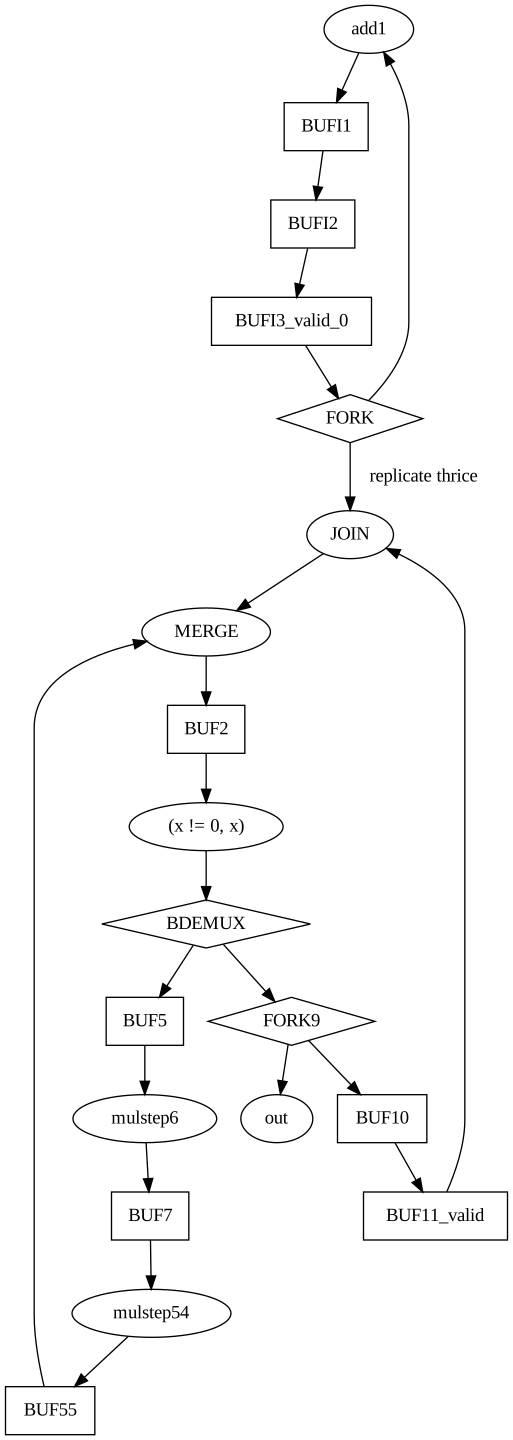
Note, we use a simpler, less expensive, construction for the conditional iteration as having independent control-flow for the trivial condition is overkill.
How to test
As mentioned, the data is presented using the standard 4-phase (RTZ) protocol (idle, Req, Req+Ack, Ack, idle, ...). To test, drive ack manually (any sufficiently low frequency should be work) and observe the changes in req and data. If everything works correctly, the circuit should generate 0, 2, 6, ..., x(x+1), but presented on result as x ^ (x >> 15).
To get a continuous stream, simply tie ack to req (however it's possible that data will transition to quickly for the output bandwidth -- TBD).
External hardware
Results are directly observable from the RP2040.
IO
| # | Input | Output | Bidirectional |
|---|---|---|---|
| 0 | ack | req | result_7 |
| 1 | result_0 | result_8 | |
| 2 | result_1 | result_9 | |
| 3 | result_2 | result_10 | |
| 4 | result_3 | result_11 | |
| 5 | result_4 | result_12 | |
| 6 | result_5 | result_13 | |
| 7 | result_6 | result_14 |